Passing a bill as an intern in New York's legislature | Agu Vaitkus
42.65°N 73.76°WJune 20235 min
Passing a bill as an intern in New York's legislature
Backroom politics, disillusionment, and pounding the pavement: how I navigated New York's legislature to draft, negotiate, and pass legislation as an intern.
case study · portfolio piece
S6162/A6845 -- "Liam's Law"
Context: My legal name is Agu, but I used to go by Liam -- so you’ll see “Liam” here.
Challenging the status quo
When I was younger, I wanted to be a police officer -- until I learned that my color blindness was potentially disqualifying. I was frustrated at the time, because my condition was mild. Day to day, I had no trouble with colors. But I would fail the standardized clinical tests that New York uses to disqualify applicants.
Candidates technically had the right to challenge a color vision test result, but doing so meant paying for an out-of-pocket review by a clinician -- who was still limited to using similar clinical tests. The process deterred applicants and was burdensome for both candidates and departments.
I set out to challenge this.
The idea was simple: use these broad tests as a first screen, not an automatic pass/fail. Flagged candidates move on to a practical field test, where departments check whether they can safely identify vehicle colors, traffic signals, and other critical cues in the real world. The Municipal Police Training Council, New York's expert body on police training, would approve the tests. Other states had already done the same.
When I was interning with Senator Rachel May, I presented the idea of reform to her. She gave me the green light, and I got moving.
Pounding the pavement
I spent the first month researching and collaborating with legal experts and legislative historians to design a fair, practical reform for this part of the police hiring process. By the end, we had a bill draft ready to file. It was go time!
Over the next two months, I relentlessly reached out to stakeholders -- police unions, committee chairs, ophthalmological associations, their staff, and others -- to garner support.
After some negotiations and board votes, I got the buy-in of some of the largest statewide police unions in New York.
NYS Troopers PBA memo of supportNYS PBA memo of supportNYS Association of Chiefs of Police memo of support
NYS Troopers PBA memo of support · NYS PBA memo of support · NYS Association of Chiefs of Police memo of support
At the same time, I was knocking on doors of key committee members nearly every day to bring attention to the bill, and share why it would be relevant for them to support it. I’m sure their staff got tired of how often I showed up -- but it worked!
We got the bill on a committee agenda in both houses, and it was reported out (in other words, it was passed onto the floor)!
The rush to the floor
Getting the bill to a floor vote was the real test. With leadership controlling the calendar, we had to hustle for their attention. Working with stakeholders and Sen. May’s team, we targeted the Speaker and Majority Leader -- showing up at receptions, catching them and their staff in the hallways, and promoting the bill at every opportunity.
It was working. People I’d never met were stopping me in the hallway to talk about it. We were generating conversation around an issue that’s usually overlooked -- and in a session dominated by bail reform, healthcare, and so many other big-ticket items, seeing people pay attention to color-vision accessibility felt so rewarding.
Suddenly, we saw the bill pop up on the floor calendar, which meant leadership believed it could pass and put it up for a vote.
It passed both chambers. In the Assembly, unanimously -- in the Senate, 61 to 1.
WE DID IT!
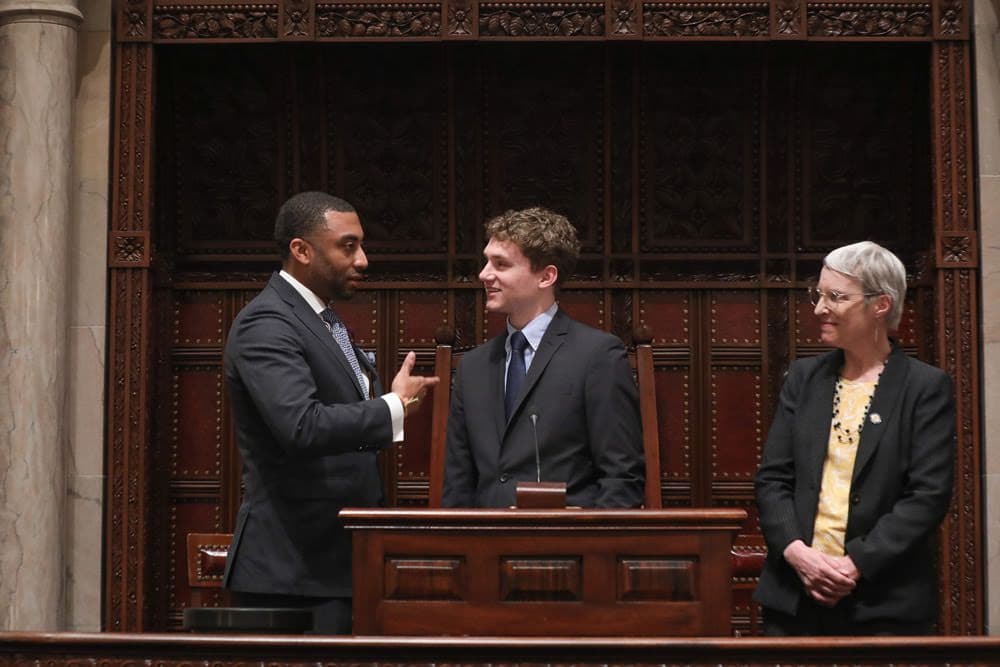
Standing in the Senate chambers with Sen. Bailey and Sen. May
The bill was then delivered to the Governor's desk.
I worked with our team to lobby the Governor's office as best as we could. The unions sent letters to her office urging her to sign it into law, too.
We were on the edge of our seats for a while, waiting for her decision. She could sign it into law, or veto it.
"Surely, this is a straight shot", we said to ourselves. We have a broad coalition of support, it passed both houses almost unanimously, and it offers a no-brainer fix to an exclusionary hiring system in New York.
Especially at a time when there was a dangerous shortage of police officers in the state, we thought the bill was a slam dunk, and there was almost no chance she'd veto.
A campaign event with Governor Hochul, where, of course, I advocated for the bill
We were wrong
To our surprise, Governor Hochul vetoed the bill on procedural grounds.
The Governor's veto message
Our team, the police agencies, and unions we were working with were disappointed. We felt like the Governor's note misunderstood the bill.
I had thoughtful answers to the Governor’s concerns, but the only call we received was to notify us of the veto -- without room for further discussion. I felt defeated.
I came to accept the decision. A veto is like a black mark on any bill. It requires an enormous amount of political capital to override, and bills that are vetoed rarely regain momentum in future sessions. Ultimately, I was feeling grateful we even got it this far. At the start, I wasn't even sure if we'd get the bill on a committee agenda.
Nevertheless, we kept trying. The bill passed the Senate one more time after the veto, with lawmakers expressing their disappointment in the Governor's decision to axe the bill and hope that this time, it will become law.
Unfortunately, the bill didn't move in the Assembly that year.
Gratitude, growth, and discovery
At the end of our internship program, we had to write reports to the program director about our experience. A fellow intern wrote about his experience watching the bill's development from his office, and I'm still touched by his words. He's a witty writer, and I was always engaged by his takes on the issues.
A note a fellow intern wrote in his end of year report (yes, he was an audacious fellow!)
Apparently, this bill was incorporated into the Senate’s internship orientation program as an example of what's possible. I've been shocked by interns from future classes coming up to me, knowing my name despite us having never met, and telling me about how cool my bill was. I was so happy to learn that this lit a fire for future generations!
Regardless of the outcome, I felt immense gratitude for having the chance to work on this idea. I feel honored to have been able to learn from and collaborate with such knowledgeable mentors, experts, and advocates. I gained incredible insight into the legislative process, and built memories navigating it that I know I'll cherish forever.