35.88°N 106.30°WNovember 20252 min
Reflections from Los Alamos
Thoughts on the ethical implications of technological innovation, and the history of the Manhattan Project.
travel · history · reflections
Thoughts on the ethical implications of technological innovation, and the history of the Manhattan Project.
Los Alamos is a remote town in Northern New Mexico. It was largely uninhabited until 1917, when a small ranching school was established in the town. That's partially why the U.S. Army came knocking in 1942.
Army General Leslie Groves was searching for an ideal location to house part of the country's top-secret nuclear program -- the Manhattan Project. Dr. Robert Oppenheimer, the Manhattan Project's Scientific Director, traveled New Mexico's countryside on horseback before and was familiar with the ranching school. He recommended Los Alamos for its isolated location and the ranching school's existing running water infrastructure.
Los Alamos was selected, and the town was bought out by the United States to develop “Site Y” -- the Los Alamos National Laboratory. This would later be the birthplace of Fat Man and Little Boy, the nuclear bombs dropped on Hiroshima and Nagasaki in 1945, changing the course of human history.
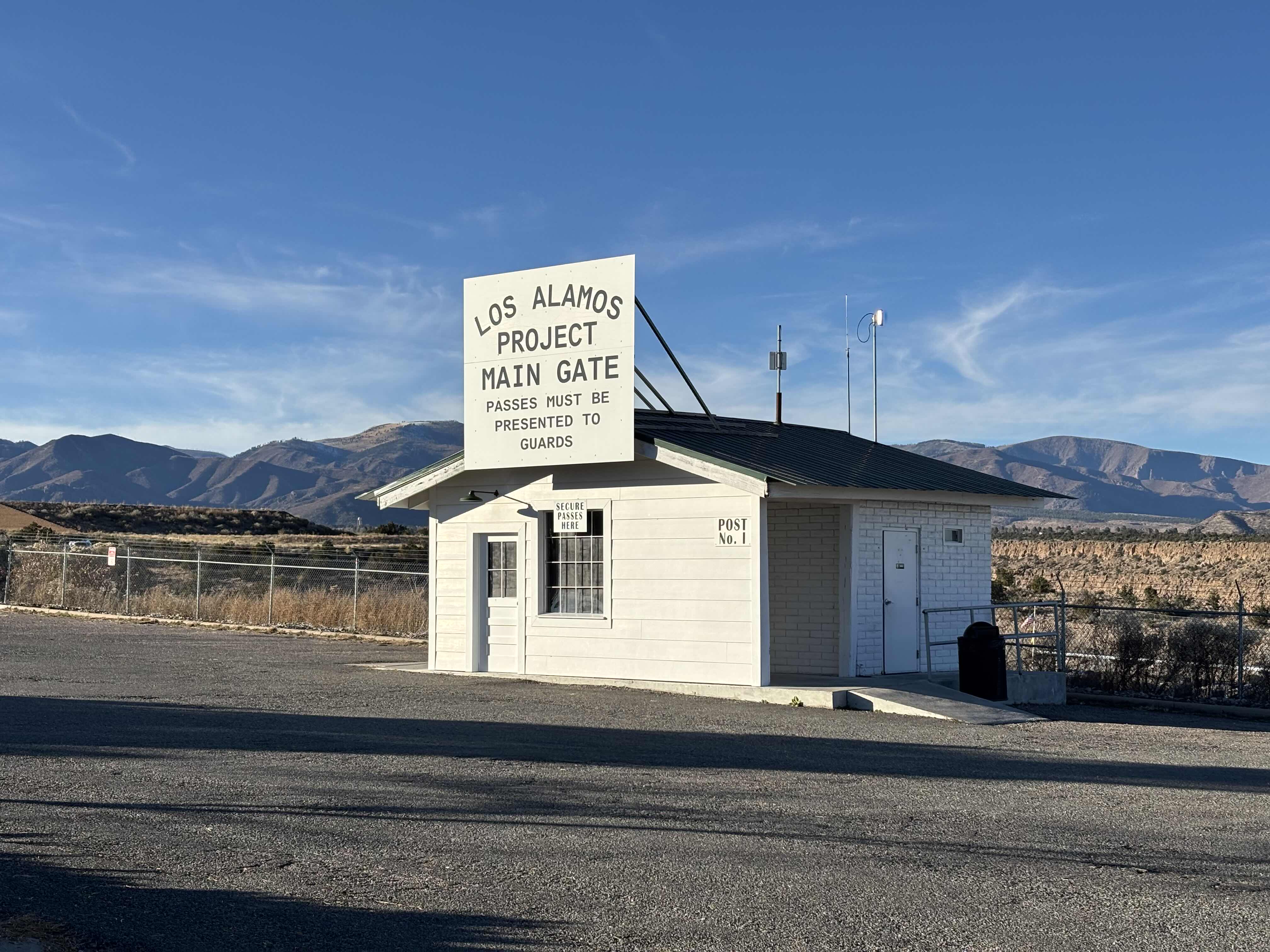
Los Alamos gate replica
I was originally drawn to explore Los Alamos because I was deeply moved by Chris Nolan’s Oppenheimer, and its reflections on the ethical complexities of innovation.
The film depicts a discovery made by Los Alamos researcher Edward Teller, who found that there was a theoretical possibility for a nuclear bomb’s immense heat to trigger a runaway thermonuclear fusion chain reaction -- releasing enough energy to “burn” the entire atmosphere and consume the Earth upon detonation.
Although this scenario was later proven to be essentially impossible, Oppenheimer realized that while his work may not have destroyed the world in a total physical sense, it abstractly did so by unleashing a nuclear arms race and creating the first man-made path to humanity’s self-destruction.
Nolan touches on this at the end of his film, when Oppenheimer tells Albert Einstein:
“When I came to you with those calculations, we thought we might start a chain reaction that would destroy the entire world.”
Einstein replies:
“I remember it well. What of it?”
The movie closes when Oppenheimer hauntingly says:
“I believe we did.”
Oppenheimer campaigned for peace and nuclear disarmament for the remainder of his life.
Statue memorializing a photo of Dr. Oppenheimer and General Groves standing at Ground Zero at Trinity Site after a successful plutonium bomb test in 1945.
Standing in Los Alamos, I felt the weight of this history and the staggering capacity of human collaboration, intellect, and perseverance. Oppenheimer's team was in a unique position: operating under wartime urgency, uncertainty, and the hope that their work would bring peace to the world.
Ultimately, the Allies emerged victorious in ending the second world war -- but now, decisive control over humanity's fate will forever lie in the hands of a few people because of what was conceptualized and built here.
I thought to myself: "this tiny town changed the world."
The story of Los Alamos reminds us to pair ambition with humility, curiosity with thoughtfulness, and technological power with human responsibility. This is equally pertinent today as we race to develop artificial intelligence, biotechnology, and other innovations.
What a profound lesson these grounds have taught us.